
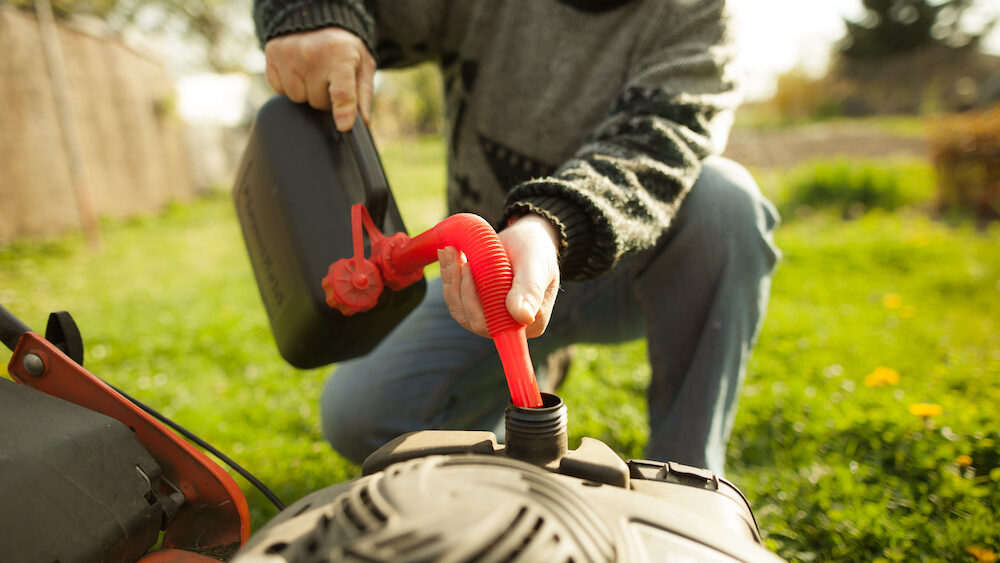
Today’s engines are more efficiently engineered than ever before, but you should still protect them with fuel stabilizers. Engines run on gasoline containing some percentage of ethanol. But gasoline left unused for more than a month in a gas tank degrades, burns poorly, and can eventually even cause engine failure. There is a way to protect your yard equipment and seldom-driven vehicles so those engines keep running smoothly.
How gasoline degrades
Fresh gasoline begins to degrade in as little as three weeks. Gas stored in jugs or in machine tanks for long periods can turn to varnish. This is particularly true of any gasoline with ethanol, which is found in most gasoline in use today.
Fuel stabilizers are bottled additives that can be measured and poured into jugs of stored gasoline, as well as into the tanks of yard machines and seldom-driven vehicles.
These additives slow—but do not entirely prevent—the degradation of gasoline. There are also stabilizers for diesel fuel.
How to use fuel stabilizers
When adding stabilizer to stored gasoline, read the specified mixture ratio per gallon and pour that amount into the storage jug. Then fill the jug with gas.
If you’re adding it directly to the machine’s tank, pour in the stabilizer required for the tank’s capacity, then fill the tank. Start and run the engine for 10 minutes to distribute the stabilizer throughout the engine, carburetor, or injection system.
One more tip
For machines that go for long periods without use, such as lawn mowers, tractors, and weed trimmers during the winter months, it is a good idea to start them every few weeks and let them run for about 10 minutes. This keeps the system from building up varnish during dormancy. For vehicles, start them up and drive them around for 20 to 30 minutes. Not only does this keep the fuel system clean, but it also lubricates seals as engine oil flows through.
Brands of fuel stabilizers
There are several brands of stabilizers on the market, with Sta-Bil being the most well-known. Products are available at any auto parts store or big-box home-improvement center.
Related – Cutting Edge Advice on Buying a Lawnmower